Formula 1 rewrote its rulebook for 2026, and the cars on track this season are the most different in a generation. If you're new to the sport, the jargon can feel overwhelming — MGU-K, downforce, ground effect, dirty air. This guide breaks it all down in plain English, using the x-ray diagram below as our map. No prior knowledge needed.
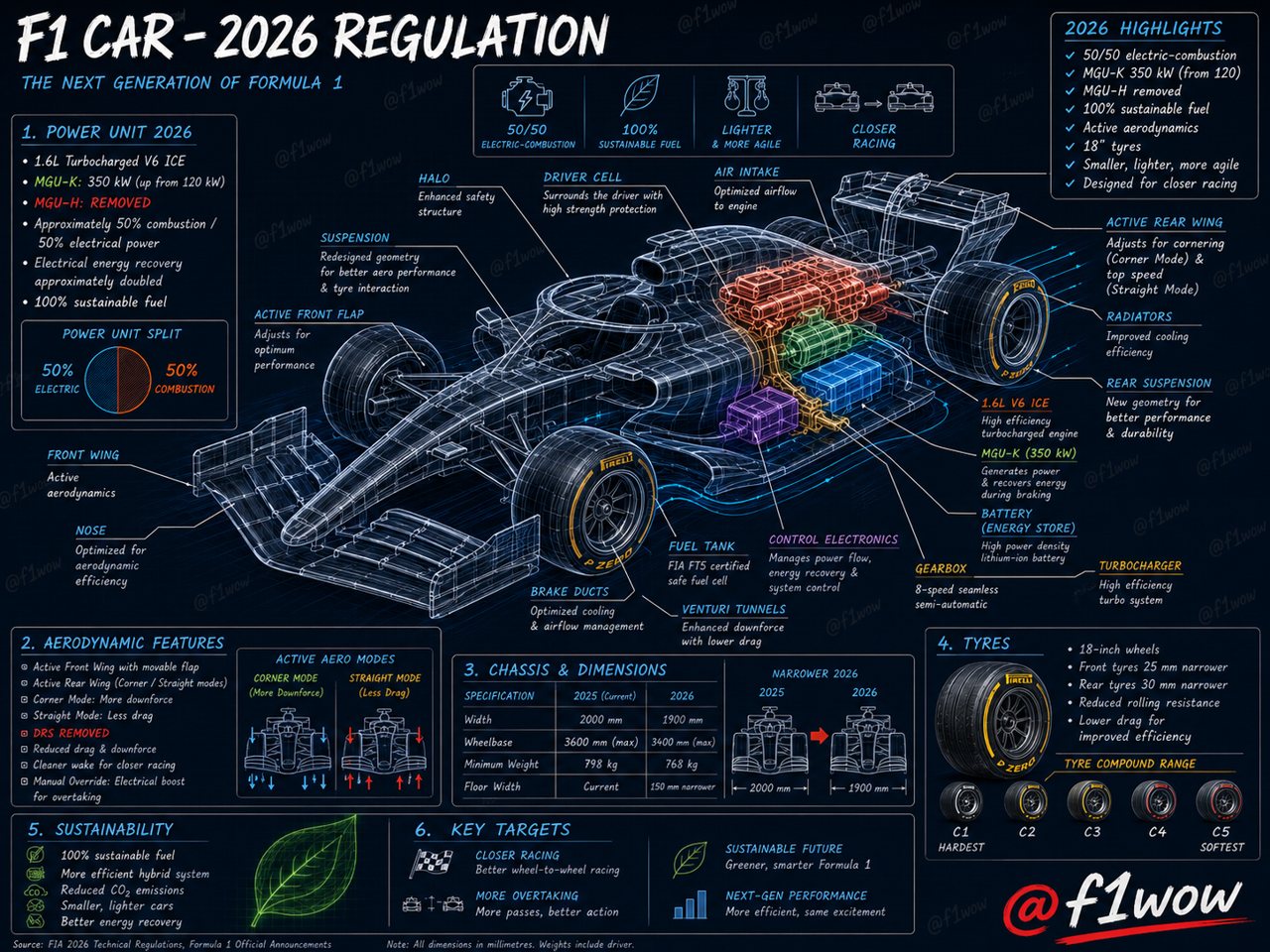
The Big Picture: Why 2026 Is a Reset
Every few years Formula 1 introduces a new set of technical regulations — the rules that define how the cars must be built. When the rules change a lot, teams effectively start over: old designs become illegal, and whoever nails the new formula first can dominate. The 2026 rulebook is one of those big resets, and it chases three goals at once: closer racing, road-relevant green technology, and smaller, nimbler cars.
Think of a regulation change like football changing the size of the pitch or the offside line: the same sport, but the tactics change. For 2026, almost every major system — engine, aerodynamics, tyres, dimensions, weight — has been redesigned. Here's what each one does, and why it matters.
The Power Unit, Explained
Formula 1 cars don't have a simple "engine" — they have a power unit: a hybrid system that combines a petrol engine with electric motors and a battery. In 2026 this system was overhauled more than at any point in the hybrid era.
At its heart is still a 1.6-litre turbocharged V6 internal-combustion engine (the petrol part, or "ICE"). Bolted to it is the MGU-K — the Motor Generator Unit, Kinetic. That mouthful simply means an electric motor that works both ways: under braking it acts as a generator, capturing energy that would otherwise be wasted as heat in the brakes, and store it in the battery; under acceleration it spins back up as a motor, sending that stored energy back to the wheels as a power boost.
For 2026 the MGU-K was made almost three times more powerful — from 120 kW up to 350 kW (about 470 horsepower). Combined with a much bigger, more energy-dense battery, the result is that roughly half the car's power now comes from electricity, up from around 20% before. Driven flat-out, a 2026 car is nearly a 50/50 hybrid.
One thing that is gone is the old MGU-H — a second motor that used to recover energy from the hot exhaust gases. The FIA removed it for 2026 to simplify the engine, cut costs and make the series more attractive to new manufacturers like Audi. (If you see the MGU-H listed on older diagrams or posters, that part no longer exists on the 2026 car.)
Feeding the engine is a 100% advanced sustainable fuel — a "drop-in" fuel made from sustainable sources that works in a normal engine but dramatically cuts net carbon emissions. It's the same idea being developed for road cars, which is exactly the road-relevance F1 wants.
Aerodynamics: Fixing "Dirty Air"
Aerodynamics is how the car interacts with the air — and in F1, the goal is mostly downforce, the invisible force pushing the car down onto the track so it can corner at huge speeds. The downside is that a car punches a hole in the air, leaving a messy, swirling wake behind it known as "dirty air". A driver chasing another car has to drive through that dirty air, which reduces their own downforce, overheats their tyres and makes overtaking hard. Fixing this is the single biggest aim of the 2026 aero rules.
The 2026 cars keep the ground effect philosophy introduced in 2022 — using shaped Venturi tunnels underneath the car (think of them as shaped air channels in the floor) to suck the car down, rather than relying only on big wings on top. For 2026 those tunnels are refined, the floor is narrower, and the front wing and nose are simplified so the car throws less dirty air at the car behind. The target is a large reduction in the wake, which should let drivers follow closely through corners.
The headline feature is active aerodynamics. For the first time, both the front and rear wings can change shape on the move. On a straight, the driver opens the wings into a low-drag "straight-line" mode to gain top speed; into the corners, they close up again for maximum downforce. There is even a manual override system: when a driver is close behind a rival, they can press a button to open the rear wing and get an electric boost — a tool specifically designed to help completing overtakes.
Smaller, Lighter, Nimbler
Modern F1 cars had grown long, wide and heavy, which made them sluggish in slow corners and tough to race wheel-to-wheel. The 2026 rules reverse that trend, trimming the car in every direction and shaving weight.
| Specification | 2025 | 2026 |
|---|---|---|
| Overall width | 2,000 mm | 1,900 mm (−100) |
| Wheelbase (axle distance) | 3,600 mm | 3,400 mm (−200) |
| Floor width | — | Reduced 150 mm |
| Minimum weight | 798 kg | 768 kg (−30) |
| Tyres | 18 inch | 18 inch (new compounds) |
The shorter wheelbase (the distance between the front and rear axles) and narrower track make the car more agile — it changes direction more willingly — while being roughly 30 kg lighter helps acceleration and braking. Overall length stays around 5.5 metres, so the cars are still long, but they are noticeably trimmer than before.
Tyres, Gearbox and Suspension
The tyres stay at 18 inches (the rim size, set since 2022) but supplier Pirelli developed new compounds tailored to the lighter, nimbler 2026 car and its different aerodynamic loads. The front tyres are slightly slimmer to match the reduced car width.
The gearbox remains an 8-speed sequential unit — meaning the driver shifts through eight forward gears sequentially, without a clutch pedal (other than at the start), using paddles behind the wheel. The suspension has been redesigned so it is less sensitive to the airflow it generates, which again helps reduce the dirty-air problem for the car behind.
Built for the Planet
Sustainability runs through the whole 2026 package. The switch to 100% sustainable fuel is the centrepiece, but it is paired with a far more efficient hybrid power unit, a lighter car (less mass to lug around means less energy used) and a push toward recyclable materials in construction. It all feeds into Formula 1's wider goal of being net-zero carbon by 2030 — and, just as importantly, into developing technology that can eventually trickle down to road cars.
What It Means for the Racing
Tie it together and the point of all this is a better show. Less dirty air plus an overtaking "boost" button should mean more passing. Smaller, lighter, more powerful cars should be more spectacular to watch and harder to drive. And the sustainable hybrid tech keeps F1 relevant to the car industry's electric future. Whether the racing actually delivers is being proven week by week — follow how the season is shaping up in our 2026 mid-season review.
Jargon Buster: The Quick Glossary
- Power Unit (PU)
- The complete hybrid system: the petrol engine plus the electric motor(s) and battery. What a road-car driver would call "the engine and the hybrid bits" combined.
- ICE (Internal Combustion Engine)
- The traditional petrol-burning engine — in F1, a 1.6-litre turbocharged V6.
- MGU-K
- The electric motor that recovers energy under braking and returns it as a power boost. "K" is for kinetic (motion). Made far more powerful for 2026.
- MGU-H
- An older electric motor that recovered energy from exhaust heat. Removed for 2026.
- Downforce
- The downward push created by the car's wings and floor that presses it onto the track so it can corner fast.
- Dirty air
- The turbulent wake behind a car. Driving through it reduces a chasing car's grip — the main thing 2026 aero aims to fix.
- Ground effect / Venturi tunnels
- Generating downforce from shaped channels under the car's floor rather than only from wings on top.
- Active aerodynamics
- Wings that change shape on the move — low-drag on straights, high-downforce in corners — new for 2026.
- Sustainable fuel
- A drop-in fuel made from sustainable sources that works in a normal engine but cuts net carbon emissions.
- Wheelbase
- The distance between the front and rear wheels. Shorter = more agile.